Tuesday, January 4, 2011

Dilma Rousseff becomes first female president of Brazil

President Dilma Rousseff belongs to PT (Workers' Party) while Governor Geraldo Alckmin of Sao Paulo state is with the PSDB (Brazilian Social Democracy Party).  There are 27 states including the federal district where the national capital Brasilia is located. State governors--also powers to reckon with--assumed office on New Year's Day. 
On New Year's Day, Dilma Rousseff became the first woman to become president of Brazil in 121 years.  She garnered 56% of the popular vote in the run-off elections last October.

Dilma was a student activist and joined the leftist resistance against the military dictatorship in the 1960s.  She was tortured jailed for three years, and went back to school upon her release.

Governor Antonio Augusto Anastasia of Minas Gerais state is not a Dilma partymate. He belongs to the PSDB also like Alckmin of Sao Paulo.  Anastasia did not attend Dilma's inaugural reception.
 In attendance during her inauguration in the capital Brasilia were 23 heads of state including Venezuela's Hugo Chavez, Paraguay's Fernando Lugo and Uruguay's Jose Mujica, who are said to be left-leaning, nine vice presidents, 76 ambassadors and 24 secretaries of state including Hillary Clinton. 

There are now three female presidents in Latin America:  recently widowed Cristina Fernandez de Kirchner, who took over the presidency of Argentina from her husband Nestor in 2007, Laura Chinchilla who was assumed the presidency of Costa Rica in May 2010, and Dilma who inherited the reins of government from her mentor, Luiz Inacio Lula de Silva, who she served as his chief of staff and before that, as minister of energy.

Lula set the bar for Dilma's success as leader of almost 200 million people--87% approval rating after eight years that saw Brazil enjoy an economic boom and rising as a global power.

Lula and Dilma (01 December 1010).
 Lula fully backed her up during the election campaign.  Since they both belong to the PT (Workers' Party), she is expected to continue his policies.  According to reports, Dilma acknowledged that "Lula has left this legacy to me: I'll be the mother of the Brazilian people."

In her inaugural speech, she "committed to honoring women, to protecting the most vulnerable and to govern for all."  Of her 37 ministers, nine are women. Brazil is a federation of 27 states including the federal district, hence, Dilma will be working with 26 state governors who may have policy agenda of their own. They may not also be with her political party.

She also said that her government will "give great attention to emerging nations .... [it] will not make the smallest concession to the protectionism from rich nations that suffocate any opportunity for so many nations to overcome poverty through the hard work of production."

Dilma Rousseff is coming in as Brazil faces bright prospects in the exploitation of its massive offshore oil reserves, and prepares to host the Copa Mundial in 2014 and the Summer Olympics in 2016 while struggling with povery, crime and corruption.  She vowed "to help eradicate extreme poverty in the next decade."


Sources:

1.   Baker, Hazel. (2011, Jan 01). Brazil hands power to first female president. Sky News Online. Retrieved from http://news.sky.com/skynews/Article/201101115877045

2.  Moura, Helena de. (2011, Jan 01). Brazil inaugurates first female president.   CNN World Online. Retrieved from  http://articles.cnn.com/2011-01-01/world/brazil.female.president_1_first-female-president-luiz-inacio-lula-brazil?_s=PM:WORLD

3.  BBC News. (2010, Oct 31). The women presidents of Latin America. BBC News Latin America & Carribean.  Retrieved from http://www.bbc.co.uk/news/world-latin-america-11447598

Saturday, January 1, 2011

January 1 is not New Year to other cultures ...


Our translation of bottom text:  "Not all will celebrate tonight (New Year's eve).  Although the impression is of being a universal celebration, other cultures and faiths will not celebrate the arrival of a new year this evening. Aside from the Gregorian calendar, which governs the western world and the most widespread, the Hebrews, the Chinese and the Arab world have another accounting of the years. For them, this is just another night." 

Source:  El Commercio (2010, December 31). Lima, Peru. Retrieved from http://elcomercio.pe/.

The newspaper El Commercio of Lima, Peru had it in the front page feature (above) that, yes, there are other cultures that do not celebrate New Year on 01 January. People like us whose lives are governed by the Gregorian calendar (actually Christian, which replaced the pagan Julian calendar) marked the coming of the New Year last night with the usual merriment and noise, firecrackers and fireworks, and tables heavy with round fruits and favorite special dishes.

The Chinese will have their new year on 03 February, the Hebrews on 29 September, and the Muslims on 26 November, in the Gregorian year 2011. It's going to be year 5772 among the Jews, year 4709 to our Chinese friends, and year 1433 to our Muslim brothers.

It's only the Gregorians who have a fixed-date New Year (01 January). 

The Chinese move it in accordance with their 12-year cycle, and their new year comes either in January or February. The coming one is their Year of the Rabbit; next year, it's going to be Year of the Dragon, and new year will be 23 January.

The Jewish new year is more popular as Rosh Hashanah, a holiday in the United States, which is a moveable feast based on the day of the Passover, a religious event to Christians who read the Old Testament.  The Rosh is on the 163rd day after the first day of the Passover, and the Jewish year 5772 starts on the Gregorian date 29 September 2011.

The Islamic calendar is shorter by 11 to 12 days than the Gregorian, and it is based on lunar and astronomical calculations.

There is also the Buddhist calendar. Among themselves, the Buddhists have different new years, all lunar festivals.  In the Theravadin countries (Thailand, Burma, Sri Lanka,Cambodia and Laos), new year is lunar, and it comes three days after the first full moon day in April.  The Thais, Cambodians and Laotians follow the same Buddhist calendar.  In the Mahayana countries (Tibet, China, Mongolia, Vietnam, Korea, Japan, Nepal and Indonesia), the Buddhist New Year starts on the first full moon day in January. Tibetans usually celebrate one month later than the Chinese, Koreans and Vietnamese though (Buddhanet, 2010 at http://www.buddhanet.net/festival.htm ).

In the Philippines, tt's not surprising that most of the Pinoy's superstitions about New Year are Chinese-influenced. The Sangleys were trading with this archipelago long before the Spaniards claimed it to be become Las Islas Filipinas.

The Chinese in the Philippines of course celebrate twice--the Gregorian and their own,which would be in February yet. Last night was Manigong Bagong Taon (Happy New Year); next month will be Kung Hei Fat Choi (Gung Hay Fat Choy).

Today (01 January 2011) in numerics is 1-1-11, which elicited the same lucky-number kind of excitement as 10-10-10 (10 Oct 2010) because it also occurs very, very rarely. 

Sunday, December 12, 2010

Wikileaks' underground bunker in Sweden

Wikileaks' internet servers are operating in an underground nuclear-proof bunker in Sweden. The front page photo (below) of the Gold Coast Bulletin issue of December 10, and twelve more in the inside pages remind us of the futuristic sets of science-fiction movies.

In contrast, it's jail for Julian Assange, and he's not been allowed to bring his computer to his detention cell.  His arrest has not stopped the leaks though, the latest having to do with Pope Benedict XVI and the Vatican regarding Turkey, Anglicans and child sex abuse.

Wikileaks was on the move after the shut-out by Amazon.com, but then around 500 mirror sites sprang up from around the cyberworld capable of releasing the 250,000 US embassy cables anytime.

When Assange was denied bail, Operation Payback, an activist group, attacked the MasterCard and Visa websites, among others.

What would happen if Assange is extradited to Sweden to face the rape charges against him? An arrest warrant went out not because of Weakileaks but of sexual crime he allegedly committed when he visited that country earlier this year.

What would happen if Sweden delivers Assange--the "Ned Kelly of the digital age" to the Sydney Morning Herald--to American custody for a possible espionage case?

Wednesday, December 8, 2010

Imagine John Lennon on his 30th death anniversary

We were a provincial lad, thin and with a thick, hard-to-comb, curly bush of hair, transplanted from the old hometown for the first time ever to the freshman dormitory of the Philippines' premier state university when the Beatles long-playing album A Hard Day's Night (June 1964) had just been released.  Thus, hardly a day or night passed without someone warbling--without apologies to John Lennon-- I Should Have Known Better along the dorm's long corridors or in the shower room for quite a long period of time.

To us, the Beatles was John Lennon and/or Paul McCartney. The songs we loved simply got stuck in our memory.  We didn't get bothered if You've Got to Hide Your Love Away, Ticket to Ride and Norwegian Wood were Lennon's, and Yesterday, Michelle and Hey Jude were  McCartney's, although they were marked up as Lennon/McCartney collaborations.  

Hey Jude remains a favorite. In some ways it was the theme song of our fraternity's final rites in October 1968, a few months after it was released, because almost everyone would break into singing it whole or in parts every so often during the informal sessions with our candidate brothers.   It doesn't matter that McCartney wrote it to comfort Julian Lennon  after his father left him and his mother Cynthia for Yoko Ono earlier that year.  

John Lennon and Yoko Ono we remember so well for their pacifist stance, and their nude photo in the cover of their album Two Virgins in 1968. 

While we somehow lost much of our Lennon/McCartney consciousness during the people's long marches in the late 1960s, we still responded to their Give Peace a Chance (1969) and Lennon's Imagine (1971) with a different kind of dynamics. These songs came at the height of the American war in Vietnam, and the Philippines was confronting a gathering malevolent political storm.  There came different songs to voice our protests when we went through the dark night of the Philippine soul in the 1970s to 1986, pulling out from our memory's cache of  Lennon/McCartney musical gems something to imagine bright days ahead.

We also deeply grieved when Mark David Chapman shot John Lennon four times in the back thirty years ago today, on 08 December 1980, at the entrance of The Dakota on 71st Street, New York City. A few hours earlier, Chapman asked Lennon for his autograph on a copy of the Double Fantasy album cover.

"Just imagine it never happened," Darryl Sterdan, music critic of the Winnipeg Sun Media, wrote, and  that last year, "Lennon and Ono celebrate[d] their 40th anniversary by making a new CD. They pose[d] nude on the cover a la Two Virgins. Walmart refuse[d] to stock it until Lennon agree[d] to add tiny fig leaves."

This year, Sterdan added further, it would be "the Beatles embrac[ing] the digital age. Once again rejecting massive offers for a reunion tour, Lennon quietly turns 70, teaming up with Sean and Yoko to reform Plastic Ono Band and Elephant's Memory for a one-off concert. On eBay, an autographed but badly damaged copy of Double Fantasy found on the street in 1980 sits unsold."

For more of Sterdan's Just Imagine scenarios,  go to http://www.torontosun.com/entertainment/music/2010/12/02/16407886.html
His memory lives on with this official video of him singing Imagine --


For a personal homage to his memory, one can walk across the street from The Dakota to the Strawberry Fields and the Imagine memorials for John Lennon in Central Park.  It can not be missed if one follows the trail on the west side.  The day we went last year, the memorials were not crowded. 


Monday, December 6, 2010

New lands for the FIFA World Cup; vuvuzelas in Russia, 2018 and Qatar, 2022

It also happened that England was snowbound on the day it lost its bid to host the World Cup in 2018.  The idiom "under the weather" is indeed apt. 

Despite their strong presence in Zurich, Prime Minister David Cameron, Prince William and former football captain David Beckham did not fire up enthusiasm among the 22 members of the FIFA governing body, which gave England only two votes. 


On the other hand, Russian Prime Minister Vladimir Putin canceled initial plans to be there before the secret voting.  Despite his absence, Russia won the bid, reason for him to fly to Zurich to receive the award.  "If you don't take risks, you don't drink champagne," he's reported to have quoted this Russian saying.

Football fans may expect Russia to build stadiums in 13 host cities from Kaliningrad in the west to Yekaterinburg in the east at a cost estimated at around $10 billion. 

Beckham could only cry for England's bitter disappointment. The other losers were Holland-Belgium and Spain-Portugal. 

US President Obama, on the other hand, accused FIFA for making a "wrong decision" when the hosting of World Cup 2022 went to Qatar.  The US, Australia, South Korea and Japan bid for the site.

"We go to new lands" was how FIFA president Sepp Blatter explained the choices. 

Qatar is an interesting issue. It has never qualified for the World Cup finals. It's in the Middle East, and there's the risk from desert heat. FIFA must have strongly believed that Qatar can deliver its "commitment to  

to spend $42.9 billion on infrastructure upgrades and $4 billion to build nine stadiums and renovate three others [and all of them] will have a state-of-the art cooling system that will keep temperatures at about 27 degrees Celsius (81 F)."

Recommended reading on the operational risk assessment and selection of Russia and Qatar as hosts:  "FIFA overlooks risks in picking Russia and Qatar" (04 December 2010) by Stephen Wilson, AP Sports Writer, accessible from My Star online  at http://football.thestar.com.my/story.asp?file=/2010/12/4/football_latest/20101204072455&sec=football_latest


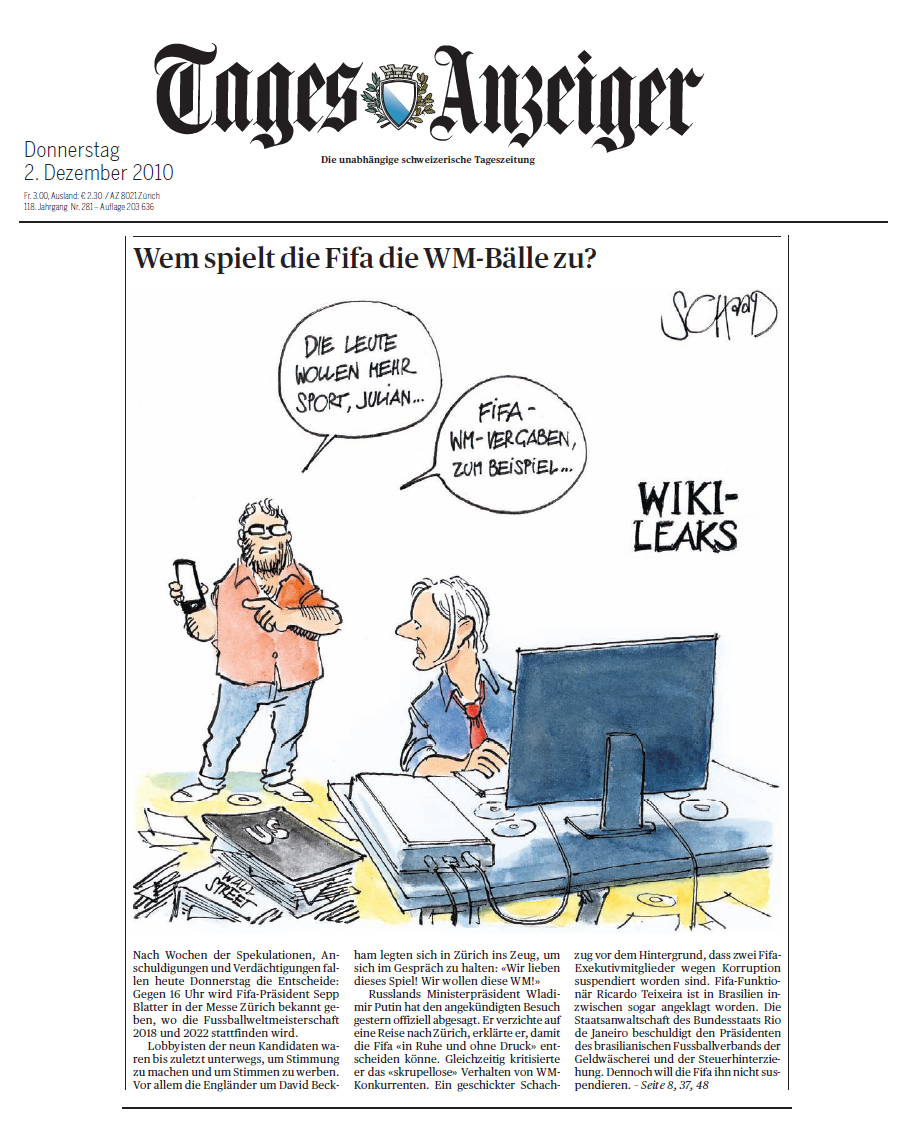
We found this front page cartoon, which came out before the FIFA selection event, very amusing.  It derives its humor from the Wikileaks, insinuating that Julian Assange could possibly do some mining in the rich field of intrigues, accusations and suspicions in international sports organizations, and in this instance, the FIFA.  Who knows if there were also "unclassified", "classified" and "secret" cables that were exchanged in the selection of Olympic, World Cup and other international sports events?

Friday, December 3, 2010

Waiting for WikiLeaks from Manila

"The United States targets Wikileaks founder Julian Assange.  Washington says the publication of more than 250,000 documents is dangerous, and calls the perpetrators criminals."
The 251,287 confidential United States embassy cables started leaking out on Sunday, November 28. 

Just a kid?
On Tuesday, November 30, we caught Secretary of State Hillary Clinton live on TV expressing America's deep regrets about the Wikileaked documents at the same time reassuring American allies. "I want to make it clear," she stressed, "that our foreign policy is not set through these messages, but here in Washington. 


Curiosity led us to Secret US Embassy Cables at http://cablegate.wikileaks.org/ the next day but we could not get to the documents anymore.  We were still able to read the explanatory notes on the cables though, and look at the the map and bar graph showing the various American embassy sources. "The full set consists of 251,287 documents," it said, "comprising 261,276,536 words (seven times the size of "The Iraq War Logs", the world's previously largest classified information release) ...the cables cover from 28th December 1966 to 28th February 2010 and originate from 274 embassies, consulates and diplomatic missions."
  
We also noted that 15, 652 of these memos are "secret",101,748 "confidential" and 133,887 "unclassified"; Iraq was the "most discussed country" with 15,365 cables, 6,677 came from there; "Ankara, Turkey had the most cables coming from it--7,918"; and 8,017 cables came from the office of the Secretary of State.

One more thing whetted our appetite to look for the leaks--The Philippine Star headlined on the same day that the Wikileaks include "1,796 US memos from [the US embassy in] Manila."  It learned from the Guardian of UK that 982 of these cables are "unclassified", 749 "classified" and 65 "secret", and "all but two of [these] were sent between January 2005 and February 2010, [with] the two ... dated Nov. 21, 2001 and July 19, 1994."  It appears that most of the information flow happened during the reign of Gloria Macapagal-Arroyo.


Until today, President Noynoy Aquino has yet to receive a call from Clinton although nothing yet of the Philippine cables have hit the remaining open online Wikileaks sources--The New York Times, Guardian of the UK, Der Spiegel of Germany, Le Monde of France and El Pais of Spain--after Amazon.com shut down its host services. It has been reported that Wikileaks has moved its site to Switzerland. 


We've seen the summary reports on the cables that have been released so far at the New York Times and Buenos Aires Herald.  The one we read with utmost delight at Spiegel Online is the confidential dispatch of 31 August 2006 with an intriguing title: "The US Ambassador Learns that Cognac Is Like Wine."  about "high society wedding in the Caucasus -- complete with massive quantities of alcohol, lumps of gold and revolver-wielding drunkards."  It's very well-written like an essay in one's favorite magazine coming in four parts, and these are just excerpts.


The latest releases (05 December) in Spiegel Online include the following:

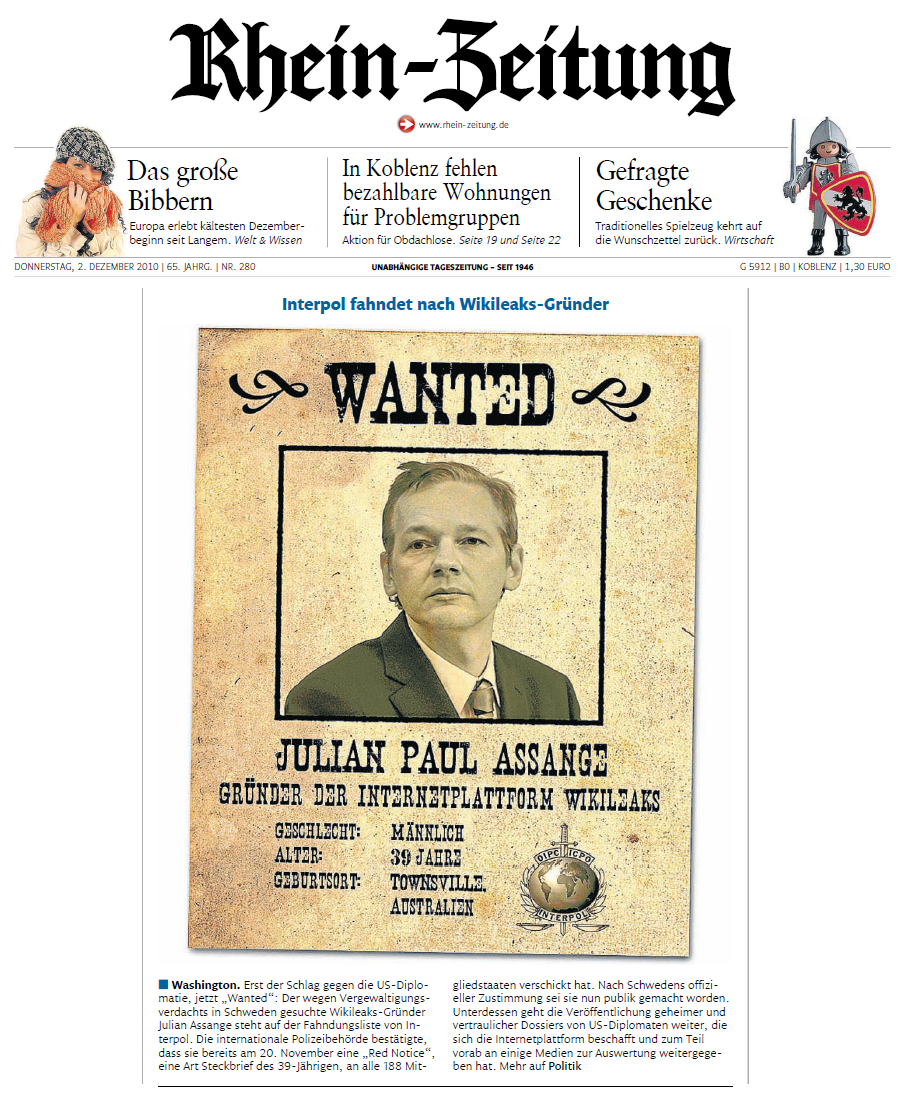
Julian Assange, an Australian citizen, is thought of as constantly moving. However, it has been reported by a British newspaper,The Independent, that the whistle blower arrived in Britain in October, the police know of his whereabouts but they have yet to serve the international warrant for his arrest.  The Interpol has issued a 'red notice' for his arrest because he is wanted in Sweden on suspicion of sexual crimes allegedly committed there earlier this year.

The fall-out has caused US President Barack Obama to create a special committee called the Interagency Policy Committee for WikiLeaks that will try to block any other leaks in the future through intelligence agency coordination within the country.

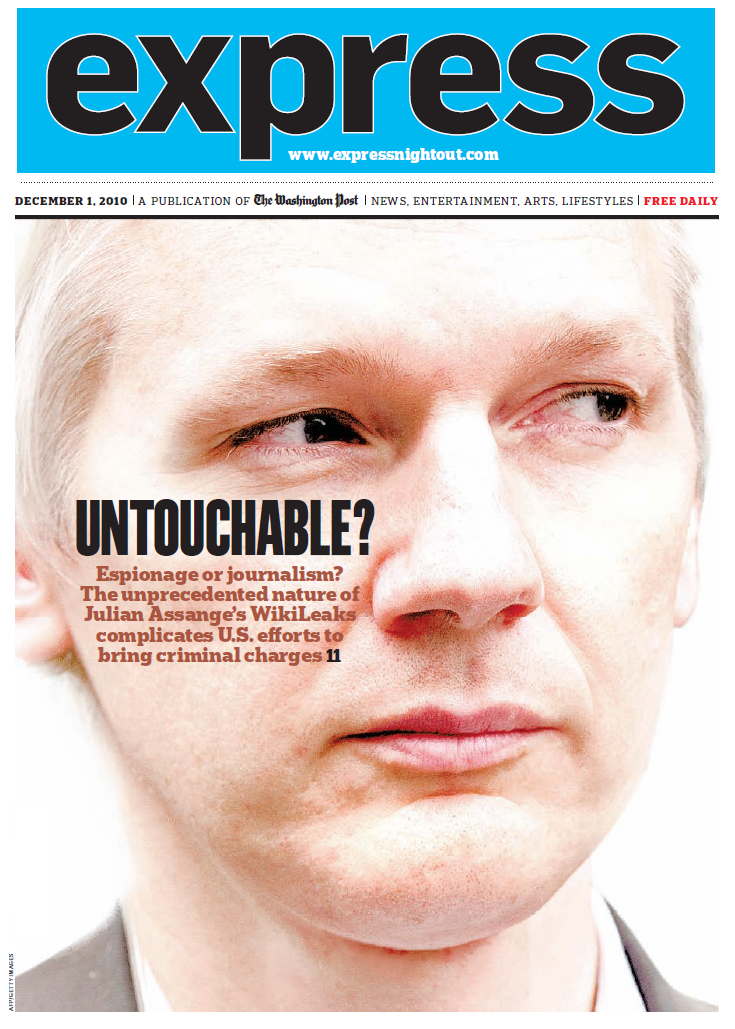
We have yet to see the US file federal charges against Wikileaks. Is cablegate a sound argument for honest journalism?


Rio War Ending: Brazil Flag Waves Over the Slums

Reconquering territory!
Military occupation.
Like any Bruce Willis do-good urban warfare movie, criminal elements either die during the eardrum-splitting exchange of gunfire, or get captured after a hot pursuit by foot or police cars through a maze of hide-outs while a helicopter hovers above for tactical support, or, to everyone's frustration, escape. 
Urban war trophies:  arms and drugs.
The paradox is that it was this urban war that appears to have given the two-year pacification program in the favelas a big push.  President Luiz Inacio da Silva was saying he couldn't understand why the criminals should be in control over the favelas; he himself dispatched 800 troopers to support the police and military forces in their assault of the Complexo do Alemao and Vila Cruzeiro. There were casualties, yes, but the operation succeeded.  The denouement had the soldiers waving the Brazil flag over the re-conquered territory.  Wanted criminals were captured, arms arsenals and drug warehouses captured. The war pains would probably be felt by the slum residents for a long time. 
A hero of the Rio war returns home to his pregnant wife.
President-elect Dilma Rousseff takes over government on December 31st.  Probably, Silva wants Dilma not to be bothered by the favela issues while she takes care of more pressing government agenda, and as Brazil prepares for the great samba welcome to the World Cup 2014 and the Summer Olympics in 2018!
A view of the two faces of Rio, the bright city and the dark slums.